
Testing a faster path to REAL ID


Reimagining identity verification for the nation’s most populous state
Context
In collaboration with the California DMV, we launched a pilot to streamline the REAL ID application process using ID.me’s document pre-verification technology.
This was ID.me’s first state government partnership — a high-stakes opportunity to prove the power of digital identity tools in a complex, real-world environment.
Objective
Design and validate a pre-verification experience that reduces in-office processing time and sets the foundation for statewide rollout.
DURATION
12 Weeks
MY ROLE
Lead Product Designer & Researcher

We traveled 2,716 miles to the CA DMV Headquarters to run the first usability study, establishing baseline data to measure future impact.
Approach
01 / Discovery
Before designing, we visited one of the busiest DMV field offices in California. I created a research plan that focused on understanding staff workflows and applicant pain points.
We observed:
– 16+ minutes per applicant spent manually scanning documents
– Repeated scanner failures, especially with passports
– Frequent document compliance issues requiring return visits
– On-site DMV registration required to begin application
These insights gave us the data we needed to shape a meaningful solution.


Our Key Takeaways
This firsthand, in-person approach proved invaluable. By capturing detailed data and benchmarks related to the applicant's journey, we identified specific issues that informed our vision while real-world data strengthened ID.me's value proposition.
01.
User Access Concerns
Some individuals must visit their local DMV office to register for a DMV Now account using onsite computer stations before starting the REAL ID Application process.
02.
Time Waste
Agents spend about 16 minutes manually scanning documents per applicant, with extra time needed for troubleshooting scanner issues.
03.
Document Scanning Issues
DMV office operators frequently had to attempt multiple scans for successful document authentication, especially with "MRZ barcodes" in passports, which often required manual rescans.
04.
Document Compliance Challenges
Applicants frequently fail to provide the required documents, leading to frustrating repeat visits and substantial financial impacts on the DMV.
02 / Strategy
I facilitated early alignment between ID.me’s product, engineering, and government affairs teams. We clarified the pilot’s success criteria, compliance needs, and technical constraints.
Key planning areas included:
-
Accessibility and localization for eight languages
-
Safeguarding PII and supporting multi-factor authentication
-
Designing without an existing DMV design system
-
Documenting complex rules for document eligibility
We broke the project into two phases:
Phase 1 – Evaluation: audit requirements and pain points
Phase 2 – Implementation: design, test, refine
Phase 1 – Evaluation


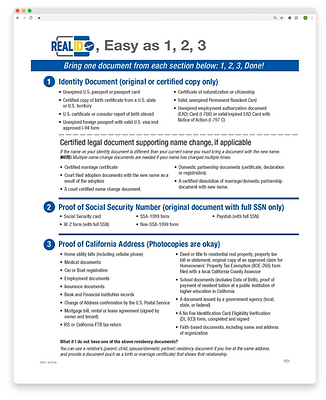
Examples of Existing Real ID documentation


Uncovering Challenges and Opportunities
During the evaluation phase, I assessed the project's needs, technical limitations, and goals. This involved consolidation data on the REAL ID application and reviewing existing processes and artifacts regarding the existing experience.
Finding #1 - California DMV's REAL ID Guidelines Are Exemplary
After researching and comparing REAL ID requirements across states, California DMV’s guidelines were found to be the most detailed and clear, effectively explaining the benefits and reasons for obtaining a REAL ID.
Finding #2 - Complex Document Validity Rules
Applicants often struggle with complex rules for REAL ID documents, including varying requirements and frequent changes. The detailed verification process further complicates ensuring all documents meet the criteria.

03 / Proof of Concept
With the evaluation phase complete, we are now ready to finalize our design strategy. We’ve developed a visual design system to ensure consistent branding across the user experience, beyond the current Single Sign-On experience.
ID.me's Technological Constraints & Unexpected Challenges
Our research identified four challenges:
Safeguarding PPI
We must implement robust measures to protect Personally Identifiable Information (PPI).
Design Parity
The absence of an existing visual design system surprised us. While the CA DMV has granted us creative freedom, establishing a strong design system is crucial given the project's scope and timeline.
Document Verification Needs
Advanced logic is required to pre-verify key documents like Name Change and Proof of Residency, necessitating design and engineering changes to meet compliance standards.
Accessibility and Localization
To accommodate California’s diverse population, our design must support translation into eight languages, ensuring accessibility and usability for all users.
Addressing these challenges is vital for improving the user experience and ensuring compliance.
Key Concept #1
Multi-factor Authentication (MFA) for Enhanced Account Protection
-
Beyond SSO Security: MFA adds an extra layer of protection by requiring multiple forms of verification, reducing the risk of unauthorized access even if passwords are compromised.
-
Privacy Enhancement: MFA ensures that only authorized users can access sensitive personal information, mitigating risks of identity theft and unauthorized data access.
-
ID.me Protocol: MFA is a standard part of ID.me’s security framework, ensuring robust protection and maintaining high standards of privacy and security for our services.

Entry Screen with Information,
Hyperlink Style

Entry Screen with Information,
Hyperlink Style

Multi-Factor Authentication Design
Key Concept #2
Standardized Global UI Patterns
-
Analyzing Design Patterns for Consistency: Before proposing a unified visual design system, I analyzed existing patterns for layout, typography, colors, and interaction. This analysis informs the development of a refined design system that aligns with ID.me standards and California's design criteria.
-
Balancing Copy Requirements for Clear User Comprehension:
1) Efficiency as Primary Metric: Designed the process in a clear, linear fashion to help applicants understand requirements and time expectations for efficient completion.
2) Simplifying Design Approval: Worked with content writers to streamline the review and approval process, focusing on consistency and simplicity for better user comprehension.
3) Reducing User Burden: Created intuitive UI and clear instructions to minimize user effort and avoid trial and error in task completion.

Key Concept #3
Touch-Enabled Device Support
-
Enhanced usability and accessibility at the DMV: Optimizing for touch-enabled devices ensures a more equitable experience for users relying on the pilot to complete ExpressLane registration online.

Here's a visual outlining the CA DMV team's specific needs and requirements was presented in technical discussions to guide our engineering team. It highlighted design breakpoints for both CA DMV and ID.me, helping with resource planning and bridging knowledge gaps.
Key Concept #4
Multiple Language Selector and Localization
-
Substantial Design and Development Time: Integrating a language selector requires significant effort, but it enhances accessibility for non-English speakers and broadens the platform’s reach.
-
Growing ID.me's Offering: Meeting CA DMV's localization requirement lays the groundwork for a more compelling product and advances our vision to make our product more equitable.
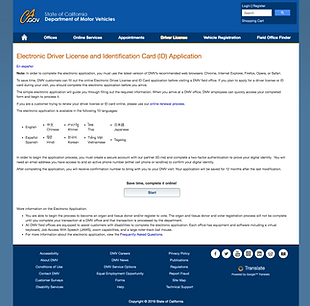
Before
Users can select a language only at entry and cannot change it during their journey.

After
The entry screen for REAL ID Express Lane provides an overview of the application process.

Language selection in the global footer allows users to switch languages easily throughout the application process.
04 / Final Design Implementation for DMV Express Lane
After a two-week design sprint and several iterations, I successfully proposed a final design that significantly simplifies the applicant's experience with document selection, upload, and pre-verification for the DMV Express Lane.
Key Highlights of the Pilot Process:
-
Streamlined Document Selection: Clear, step-by-step guidance with visual aids helps applicants choose the correct documents easily.
-
Effortless Upload: Users can upload documents via computer or take a photo, making the process more flexible and user-friendly.
-
Efficient Pre-Verification: Enhanced virtual document acceptance and clear instructions for scheduling in-person visits ensure a smooth experience in the DMV Express Lane.
Pathway to Your Real ID
Once Californians set up their CA DMV Now account, they can track the progress of their REAL ID application at any time.


Step 1: Simplifying Communication for California’s Diverse Population
With the redesign, the REAL ID Application Checklist now supports easy translation into eight different languages, ensuring clear and accessible communication for California’s diverse community.
Step 2: Gathering and Selecting Documents
Our approach combines conversational guidance with clear instructions and visual aids to help you select the correct documents. This method has proven effective in minimizing errors and ensuring accurate document selection.


Step 3: Uploading and Submitting Documents
To use the Express Lane, REAL ID applicants have two options for submitting their documents: upload them via computer or take a photo.

Step 4: Confirmation of Successful Document Pre-Verification
Once your documents have been successfully submitted and accepted, you can schedule an appointment for an in-person visit to a local DMV field office. This appointment is required to complete your application process.

Step 5: Scheduling Your In-Person Visit at the Local DMV
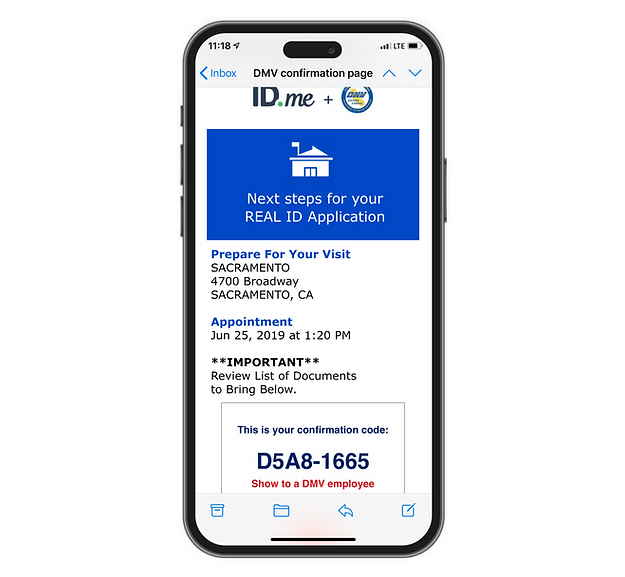
With your appointment confirmed, review the list of documents you'll need to bring for your visit.


The Final Step Awaits:
Seamless Completion of Your REAL ID Application
REAL ID applicants who schedule an in-person visit can take advantage of the Express Lane. This expedited option allows for a swift process when you present your confirmation code at check-in.

"No Identity Left Behind"
ID.me's design pattern library has been updated to include a touch-friendly user interface, making it accessible at all touchpoints. By the pilot launch, we will also support seven additional languages besides English.
This step is vital for meeting the pilot's requirements and reinforcing ID.me's commitment to our promise of "No Identity Left Behind."
Results & Impact
Design for Inclusivity
We collaborated with the California DMV to create a solution that:
• Streamlines copy for easy comprehension, making the process simpler and more engaging.
• Can be easily translated into eight languages.
• Delivers a seamless experience across mobile web, desktop, and touchscreen computers.
Exceeding Pilot Expectations
Our revolutionary REAL ID Application Process offers a viable solution that:
1. Enhances User Experience: Provides clear, guided procedures for uploading necessary identity, proof of residency, and Social Security documents prior to visiting a local DMV, reducing average wait times from approximately 36 minutes to just 14 minutes.
2. Boosts Agent Productivity: Third-party analysis shows that the ID.me pilot has led to time and cost savings, allowing office staff to avoid scanning or verifying documents during in-person visits.
3. Delivers Significant Resource Savings: An estimated 833.3 hours per day are saved statewide, resulting in $4,343,750 in annual productivity gains based on the average salary of DMV staff.